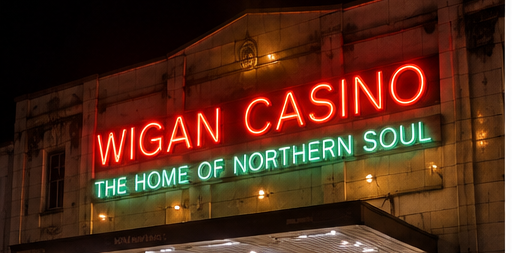

Certain things in life become part of who you are. They aren’t hobbies or passing interests; they’re woven into your identity. For me, Northern Soul and Motown have always been exactly that.
People often ask where a passion like this begins and, when I think about it, the answer is obvious. I was the youngest of four children and, like most younger brothers, I inherited far more than hand-me-down clothes. I inherited music.
Long before I was old enough to buy records of my own, our house was filled with the sounds of American soul. The voices of Marvin Gaye, The Four Tops, The Temptations, Edwin Starr, Jimmy Ruffin and countless others became the soundtrack to everyday life. My older brother and sisters introduced me to a world that felt completely different from the pop music on television. It had emotion, energy and, above all, rhythm.
Looking back now, I don’t think they realised quite what they were starting.
Around 1971, as I entered my mid-teens, the music began to mean something different. It wasn’t just something played at home anymore. It became something to experience.
Like so many teenagers of the time, I started going to the local youth club. By today’s standards, they were simple places: wooden floors, coloured lights, fizzy drinks and a record deck in the corner. Yet those evenings felt magical. The latest Motown records mixed with the growing Northern Soul scene, and for a few hours every week nothing else really mattered.
From there came the local clubs.


Every weekend seemed to offer another opportunity to hear incredible music, meet like-minded people and dance until your feet ached. Northern Soul wasn’t about fashion labels or expensive nights out. It was about discovery. Finding that obscure American record that hardly anyone else owned. Hearing a track that instantly filled the dance floor. Sharing that excitement with strangers who somehow already felt like friends.
Before Wigan, I’d already made the pilgrimage to some of the great names of the Northern Soul scene. The Twisted Wheel had helped define the movement, while The Catacombs and the Golden Torch each had their own loyal following and unforgettable atmosphere. Every venue had its own sound, its own DJs and its own personality, but all were united by a love of rare American soul records.
The Night That Became History
By the autumn of 1973, all-nighters had already become a regular part of my life. I’d travelled to several venues, danced until dawn more times than I could remember and met people who shared the same obsession with soul music.
Then came a night that none of us could have known would become part of Northern Soul history.

At 2.00 am on Sunday, 23 September 1973, I walked through the doors of Wigan Casino for its very first all-nighter.
It was the opening night.
The music started at two in the morning and continued until eight o’clock, as daylight slowly began to appear outside. At the time, it was simply another all-nighter on the calendar. None of us could have imagined that this old ballroom would become the most famous Northern Soul venue in Britain, attracting thousands of dancers from every corner of the country over the years that followed.
Looking back now, I realise just how fortunate I was to have been there from the very beginning.
There was an incredible buzz of anticipation. Everyone had heard about the new venue and wondered whether it could live up to the reputation of the clubs that had come before it.
It didn’t take long to find the answer.
The dance floor was packed, the DJs delivered exactly what everyone had hoped for and, as the hours slipped by, it became obvious that something special was happening. Nobody talked about making history. We were simply there because we loved the music.
Like most all-nighters of that era, the night built towards its own emotional finale. As the clock edged closer to eight o’clock and daylight began to creep through the windows, the DJ would play what became known throughout the Northern Soul scene as “The Three Before Eight.” Those final records signalled that another unforgettable night was drawing to a close.

First came “Time Will Pass You By” by Tobi Legend, followed by “Long After Tonight Is All Over” by Jimmy Radcliffe, before the night ended with “I’m On My Way” by Dean Parrish. Even today, those three songs instantly transport thousands of Northern Soul fans back to packed dance floors, tired legs and that bittersweet feeling that another magical night had come to an end.
Only years later did we realise that we’d witnessed the birth of a venue that would become legendary.
Over the following years, I was fortunate enough to visit many more clubs that have since become part of Northern Soul folklore. Each had its own personality. Each DJ had favourite records. Each dance floor had its own atmosphere. Yet they all shared something that is difficult to explain unless you were there.
There was no internet.
No playlists.
No streaming services.
If you wanted to hear a particular record, you travelled. Sometimes many miles. Sometimes all night. You trusted the DJs to introduce you to something new, and when they did, it felt like discovering buried treasure.
Northern Soul also taught me something that has stayed with me throughout my photography career.
Look beyond the obvious.
The biggest hits weren’t always the records that moved people most. Often it was the forgotten B-side or the obscure American release that found a second life on dance floors across Britain.
Photography is remarkably similar.
The obvious photograph is rarely the most interesting one. It’s often the unnoticed detail, the overlooked expression or the unexpected moment that carries the greatest emotional weight.
Perhaps that’s why I’ve always felt such a connection between the two.
Both reward patience.
Both reward curiosity.
Both encourage you to look just a little deeper.
Some things never leave you.
More than half a century has passed since those first nights in youth clubs, dance halls and all-nighters, but the music has never left me.
In fact, it still provides the soundtrack to much of my life. My **Classic Northern Soul** playlist remains my number one playlist on Spotify, and it doesn’t take much for the years to melt away.
One song in particular always does it.

Whenever Woolly Bully by Sam the Sham and the Pharaohs comes on, I’m instantly transported back to **The Broken Wheel** in Retford. I’m fourteen years old again, standing on the edge of the dance floor, discovering a world that would shape the rest of my life. The sights, the sounds, the excitement, the friendships—it all comes flooding back as though it happened yesterday.
People often say that music is the soundtrack to our lives.
For me, Northern Soul is much more than that.
It reminds me where I came from, the people I met, the places I travelled to and the memories I was lucky enough to make along the way. It has been a constant companion through every stage of my life, and I have no doubt it always will be.
As Northern Soul fans have been saying for generations, there are only three words needed to end this story…
**Keep the Faith.**
Leave a Reply